Types of Solar Inverters Explained: String, Micro and Hybrid
If solar panels are the part of your system everyone notices, the inverter is the unsung workhorse quietly doing the critical job of converting the DC electricity your panels generate into the AC electricity that actually powers your home. Choosing the right inverter type has a real impact on system performance, especially if your roof has any shading — here's a clear breakdown of the main options.
String Inverters: The Standard Choice
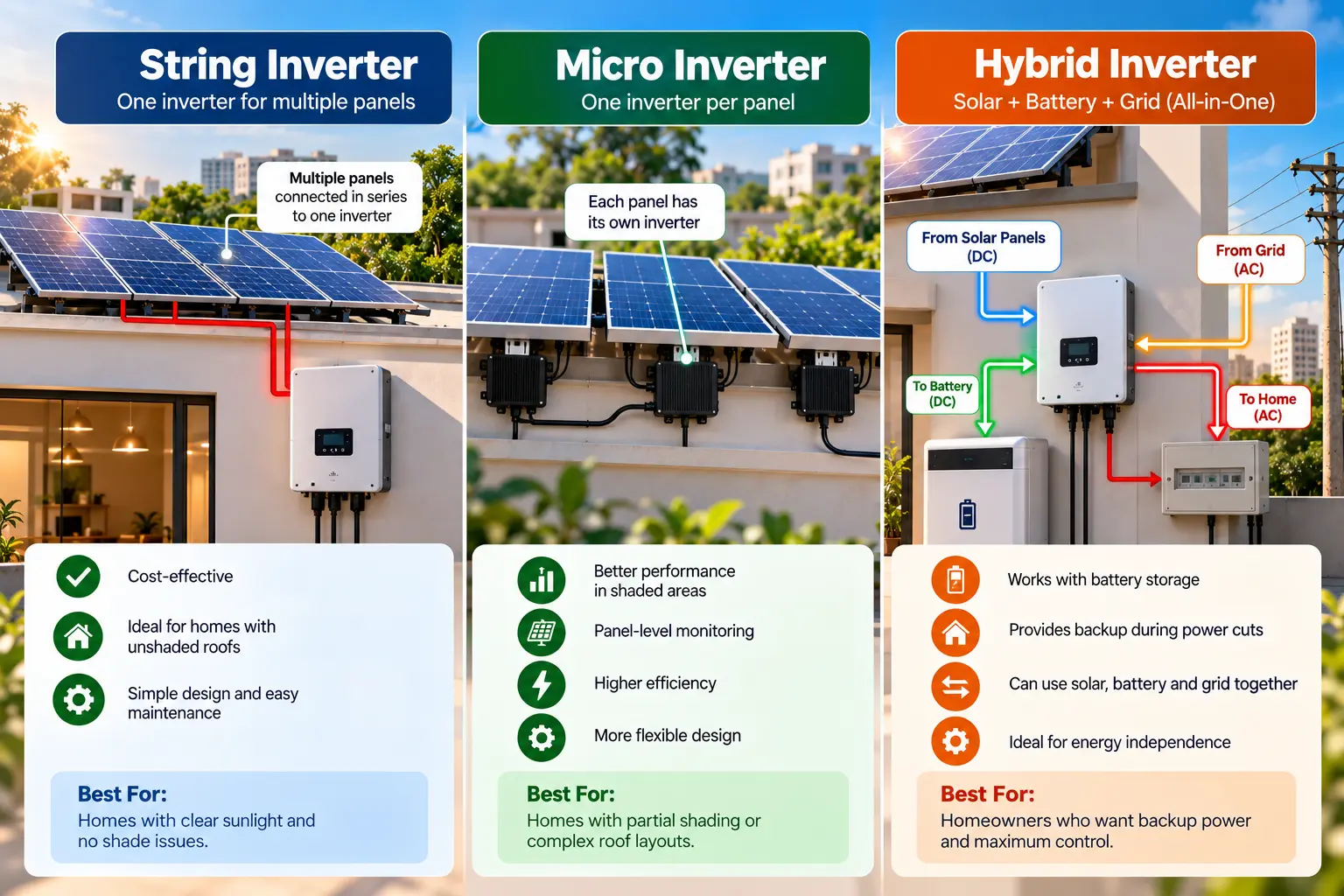
A string inverter connects all your solar panels together in one or more "strings" (series circuits), with each string feeding into a single central inverter unit, typically mounted near your main electrical panel. This is the most common and most cost-effective inverter configuration, and it works excellently for roofs with consistent sun exposure and minimal shading throughout the day.
The main characteristic to understand about string inverters is that all panels in a string perform as a group — if one panel is shaded or underperforming (say, from a tree branch, a water tank's shadow, or even just accumulated dust on one section), it can drag down the output of the entire string, not just that individual panel. For a well-positioned, unshaded roof, this rarely matters in practice, which is exactly why string inverters remain the default choice for the majority of Indian rooftop installations.
Microinverters, Power Optimisers, and Hybrid Systems
Microinverters take a fundamentally different approach: instead of one central inverter, each individual panel gets its own small inverter mounted directly behind it, converting DC to AC right at the panel level. This means each panel operates completely independently — if one panel is shaded, dirty, or facing a slightly different direction, it doesn't affect the output of any other panel in the system. For roofs with partial shading from trees, chimneys, adjacent buildings, or panels split across multiple roof faces with different orientations, microinverters can meaningfully outperform a string inverter setup, sometimes by 5–25% depending on the severity of shading.
Power optimisers offer something of a middle ground: like microinverters, they're installed at each individual panel and correct for shading and mismatch issues at the panel level, but they still send DC power to a single central inverter for the final AC conversion, rather than each panel having its own complete inverter. This typically costs less than a full microinverter system while still capturing most of the shading-tolerance benefit — a solid option worth discussing with your installer if your roof has some shading but a full microinverter setup feels like overkill for your budget.
Hybrid inverters serve an entirely different purpose: they're designed to manage not just solar-to-AC conversion, but also battery charging, battery discharging, and switching between grid and battery power seamlessly during outages. If backup power during grid failures is a priority for your household or business, a hybrid inverter (paired with an appropriately sized battery bank) is the component that makes this possible — a standard string or microinverter setup, by contrast, will shut down entirely during a grid outage for safety reasons, regardless of how sunny it is outside.
For most straightforward, unshaded rooftops in India, a good-quality string inverter remains the most cost-effective and reliable choice. It's only when shading is a real factor, or when backup power is a genuine priority, that the additional cost of microinverters, optimisers, or a hybrid system typically justifies itself — and a proper site assessment from your installer should make clear which category your specific roof falls into.
Understanding Solar Inverters
The inverter is the component that converts the DC electricity your solar panels generate into the AC electricity your home or business actually uses — and choosing the right type matters almost as much as choosing the right panels. A string inverter is the most common and cost-effective option for straightforward rooftops with minimal shading: all your panels are wired together in a "string" and connected to a single central inverter.
Where a roof has partial shading from trees, water tanks, or neighbouring structures, or where panels face in more than one direction, a solar system with microinverters (one small inverter per panel) or power optimisers can significantly outperform a string inverter, since each panel operates independently rather than the whole string being limited by the weakest-performing panel.
For homes or businesses that want battery backup for use during power cuts, a hybrid inverter is the right choice — it manages solar input, battery charging and discharging, and grid interaction all in one unit, and is a worthwhile upgrade over a standard grid-tie inverter if reliable power during outages is a priority alongside bill savings.
How Net Metering Works
Net metering is the billing arrangement that makes rooftop solar financially worthwhile for most Indian households and businesses. Once your solar system is installed, the DISCOM replaces your regular meter with a bi-directional net meter that can measure electricity flowing both ways — the power you draw from the grid, and the surplus solar power you export back to it.
During the day, your solar panels generate electricity that first powers whatever appliances are running in your home or business. Any extra power your panels produce beyond what you're using gets exported to the grid, and the net meter records this as a credit. In the evening or on cloudy days, when your panels aren't generating enough, you draw power back from the grid as usual. At the end of the billing cycle, you're only charged for the net units consumed — total units drawn from the grid minus total units exported to it.
This means the grid effectively acts as a free "battery" for your solar system during the day, and you only pay the DISCOM for the shortfall. For most homes with a well-sized rooftop system, this can bring monthly electricity bills down by 70–90%, and in some cases reduce them to the fixed minimum charge only.
Maintenance and Lifespan
One of solar power's biggest practical advantages is how little maintenance it needs. With no moving parts, solar panels typically require nothing more than periodic cleaning to remove dust, bird droppings, and pollen that can reduce output — in most parts of India, cleaning once every 2–4 weeks (more frequently during dry, dusty months, less during and after the monsoon) is enough to keep output close to optimal.
Panels themselves are extremely durable, typically carrying a 25-year performance warranty guaranteeing they'll still produce at least 80–85% of their original rated output after a quarter century — degradation of roughly 0.5–0.8% per year is normal and expected. Inverters have a shorter lifespan than panels, typically needing replacement once every 10–15 years, so it's worth factoring this into your long-term cost calculations. Beyond cleaning and an occasional visual inspection for loose wiring or physical damage, a well-installed solar system needs very little hands-on attention to keep delivering reliable output year after year.
Cost and Payback Period
The cost of a rooftop solar system in India varies with system size, panel and inverter brand, roof type, and installation complexity, but as a rough benchmark, a good-quality on-grid residential system typically costs between ₹50,000 and ₹65,000 per kW before subsidy, using Tier-1, DCR-compliant components. After applying the government subsidy under PM Surya Ghar (up to ₹78,000 for a 3 kW system), the net out-of-pocket cost drops meaningfully.
Payback period — the time it takes for your electricity bill savings to equal your net investment — usually works out to between 3 and 6 years for most residential and commercial systems in India, depending on your local electricity tariff, how much of your solar generation you self-consume versus export, and how well the system is sized to your actual usage pattern. After the payback period, the electricity generated is essentially free for the remaining 18–22 years of the panel's rated life, making solar one of the few home investments that pays for itself and then keeps paying dividends.
Why Solar Makes Sense in India
India receives an average of 300 sunny days a year and among the highest solar irradiance levels in the world, which is precisely why the country has made solar power a cornerstone of its energy policy. For homeowners and businesses, this translates into a straightforward proposition: install a solar system once, and it keeps generating free electricity from sunlight for the next 25 years or more, dramatically cutting down what you pay to the grid.
Rising electricity tariffs, frequent hikes by state electricity boards, and the volatility of diesel prices for backup power have made solar an increasingly obvious financial decision, not just an environmental one. Combined with central and state government subsidies, the payback period on a typical residential or commercial rooftop solar system in India today ranges between 3 to 6 years, after which the electricity generated is effectively free for the remaining life of the system.
Beyond the financial case, solar also insulates households and businesses from unplanned power cuts, voltage fluctuations, and the uncertainty of grid supply in many semi-urban and rural parts of the country — a benefit that's often just as valuable as the money saved.
Common Myths, Busted
A persistent myth is that solar panels don't work on cloudy or rainy days — in reality, panels still generate electricity from diffused sunlight on overcast days, just at a reduced output (typically 10–25% of peak capacity), and India's overall annual sunshine is more than enough to make solar worthwhile even accounting for the monsoon months. Another common misconception is that solar panels require constant maintenance or frequent replacement — as covered above, the reality is closer to occasional cleaning with a 25-year usable life.
Many people also believe solar is only viable for large houses or businesses with big roofs, but modern high-efficiency panels mean even a modest 1–2 kW system on a small rooftop can meaningfully cut a household's electricity bill. Finally, there's a widespread assumption that solar installation is prohibitively expensive — while the upfront cost is real, government subsidy schemes, falling equipment prices, and financing options available through most installers have brought solar within reach of a much wider range of households than most people assume.
Frequently Asked Questions
How do I know if my roof has enough shading to justify microinverters?
A good installer will assess shading patterns throughout the day (not just a single snapshot) during your site visit — as a rule of thumb, if any part of your panel area experiences shading during peak sun hours for more than a small fraction of the day, it's worth discussing microinverters or optimisers as an option.
Are microinverters significantly more expensive than string inverters?
Yes, typically — microinverter systems generally cost more upfront than an equivalent string inverter setup, given the cost of having a dedicated inverter unit per panel rather than one central unit.
Which inverter type has a longer warranty?
Warranty terms vary by brand rather than purely by type, but microinverters often carry longer warranties (sometimes 20–25 years) compared to typical string inverter warranties (5–10 years), partly because there's no single point of failure affecting the whole system.
Can I add a hybrid inverter's battery backup feature later, or do I need to decide upfront?
This depends on the specific inverter model — some hybrid-ready string inverters allow battery addition later, while others require the hybrid configuration to be set up from the start. Worth clarifying this explicitly with your installer if you might want backup power in the future but aren't ready for the cost now.
Does inverter type affect my eligibility for government subsidy?
The subsidy generally requires the inverter to meet certified technical standards (BIS certification and grid-compliance) rather than mandating a specific inverter type, so string, microinverter, and hybrid systems can all qualify as long as they meet these standards.
Final Thoughts
The right inverter choice comes down almost entirely to your roof's shading situation and whether backup power matters to you — for the majority of clear, unshaded rooftops, a quality string inverter delivers excellent performance at the best value, while shaded or multi-orientation roofs, and households prioritising outage backup, are where the additional investment in microinverters or a hybrid system pays off.