10 Essential Solar Panel Maintenance Tips for Maximum Output
One of solar power's most appealing qualities is how low-maintenance it is compared to most other home or business equipment — but "low-maintenance" doesn't mean "zero-maintenance." A handful of simple habits can meaningfully protect your system's output and extend its useful life. Here are the ten that matter most.
The Basics: Cleaning and Visual Checks
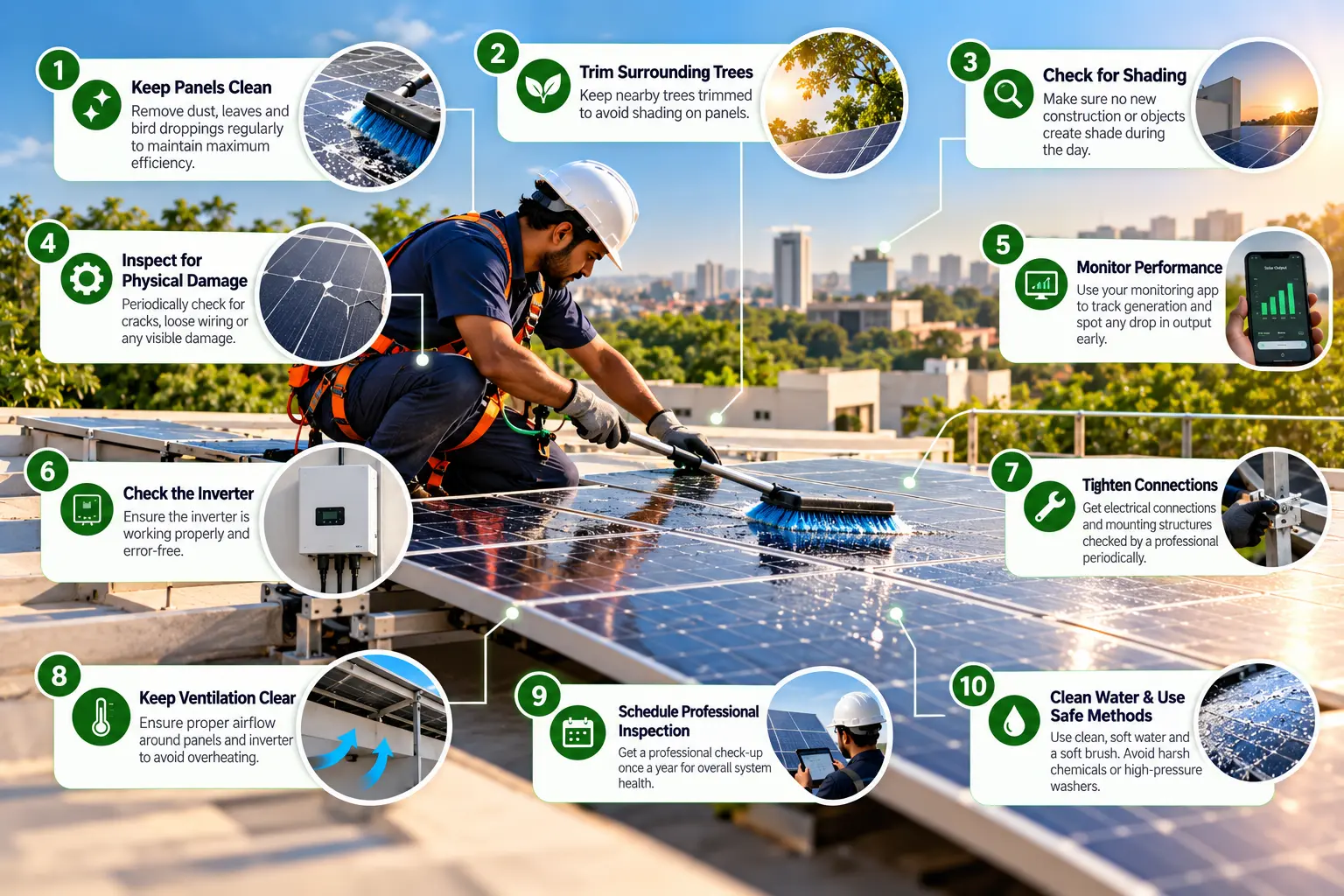
Dust, pollen, bird droppings, and general grime accumulate on panel surfaces over time and can reduce output by anywhere from 5% to 25%, depending on how dirty they get and how long the dirt sits. In most parts of India, a cleaning cycle of every 2–4 weeks during dry months (and less frequently just after monsoon rains naturally rinse panels) is enough to keep output close to optimal — use plain water and a soft brush or squeegee, avoiding harsh detergents or abrasive materials that can damage the panel's anti-reflective coating.
Alongside regular cleaning, a quick visual inspection every few months — checking for cracked glass, visible discolouration, loose mounting brackets, or any signs of water pooling on the roof around the panels — catches small issues before they become bigger, costlier problems. This takes just a few minutes and requires no special tools beyond a good look from a safe vantage point.
Eight More Habits Worth Building
1. Clean early morning or evening, never in peak afternoon heat. Pouring water on hot panels in direct midday sun can cause thermal shock that stresses the glass over time — early morning or evening cleaning, when panels are cooler, is gentler on the equipment.
2. Trim overhanging branches regularly. Even partial, growing shade from nearby trees can meaningfully cut output over time, and falling leaves or branches during storms pose a physical damage risk — a seasonal trim keeps this in check.
3. Monitor your generation data if your system has an app or portal. Most modern inverters come with a companion app showing daily/monthly generation — a sudden, unexplained drop is often the earliest sign of a developing issue (dirty panels, a failing component, or shading you hadn't noticed) worth investigating before it compounds.
4. Check wiring and connections annually. Loose connections or damaged cable insulation (from rodents, UV exposure, or physical wear) are a safety concern as well as a performance one — an annual check, ideally by a qualified technician, catches this early.
5. Keep the inverter area clean and ventilated. Inverters generate heat during operation and perform best (and last longest) when kept free of dust buildup and given adequate airflow — avoid stacking items around or on top of the inverter unit.
6. Don't ignore error codes or warning lights on your inverter. Modern inverters display fault codes for a reason — even if the system still seems to be generating power, an active warning is worth investigating rather than dismissing.
7. Schedule a professional inspection every 1–2 years. Beyond what you can check visually, a technician can test for issues like micro-cracks in cells (often invisible to the naked eye), degraded earthing, or connector corrosion that gradually affects performance.
8. Keep your warranty documentation and installation records safe. In the (rare) event of a component failure within the warranty period, having your original invoice, warranty card, and installation documentation readily available significantly speeds up the claims process.
Maintenance and Lifespan
One of solar power's biggest practical advantages is how little maintenance it needs. With no moving parts, solar panels typically require nothing more than periodic cleaning to remove dust, bird droppings, and pollen that can reduce output — in most parts of India, cleaning once every 2–4 weeks (more frequently during dry, dusty months, less during and after the monsoon) is enough to keep output close to optimal.
Panels themselves are extremely durable, typically carrying a 25-year performance warranty guaranteeing they'll still produce at least 80–85% of their original rated output after a quarter century — degradation of roughly 0.5–0.8% per year is normal and expected. Inverters have a shorter lifespan than panels, typically needing replacement once every 10–15 years, so it's worth factoring this into your long-term cost calculations. Beyond cleaning and an occasional visual inspection for loose wiring or physical damage, a well-installed solar system needs very little hands-on attention to keep delivering reliable output year after year.
Types of Solar Panels
Most rooftop solar installations in India today use one of two main panel technologies: monocrystalline and polycrystalline. Monocrystalline panels are made from a single continuous silicon crystal, giving them the highest efficiency (typically 19–22%) and the best performance in limited roof space or partial shading conditions — which is why they've become the dominant choice for residential rooftops. Polycrystalline panels, made from multiple silicon fragments melted together, are slightly less efficient (15–18%) but were historically cheaper, though the price gap with monocrystalline has narrowed significantly in recent years.
A newer generation of monocrystalline panels using PERC (Passivated Emitter and Rear Cell) or TOPCon technology pushes efficiency even higher and performs better in high-temperature conditions — a meaningful advantage during Indian summers, when panel efficiency naturally drops as temperatures rise. Thin-film panels, a third category, are lightweight and flexible but have lower efficiency and are mostly used in specialised applications rather than standard rooftops.
For most homes and businesses in India, a mono-PERC panel from a DCR (Domestic Content Requirement) approved, Tier-1 manufacturer offers the best balance of efficiency, durability, and eligibility for government subsidy schemes, which typically require DCR-compliant equipment.
Common Myths, Busted
A persistent myth is that solar panels don't work on cloudy or rainy days — in reality, panels still generate electricity from diffused sunlight on overcast days, just at a reduced output (typically 10–25% of peak capacity), and India's overall annual sunshine is more than enough to make solar worthwhile even accounting for the monsoon months. Another common misconception is that solar panels require constant maintenance or frequent replacement — as covered above, the reality is closer to occasional cleaning with a 25-year usable life.
Many people also believe solar is only viable for large houses or businesses with big roofs, but modern high-efficiency panels mean even a modest 1–2 kW system on a small rooftop can meaningfully cut a household's electricity bill. Finally, there's a widespread assumption that solar installation is prohibitively expensive — while the upfront cost is real, government subsidy schemes, falling equipment prices, and financing options available through most installers have brought solar within reach of a much wider range of households than most people assume.
Cost and Payback Period
The cost of a rooftop solar system in India varies with system size, panel and inverter brand, roof type, and installation complexity, but as a rough benchmark, a good-quality on-grid residential system typically costs between ₹50,000 and ₹65,000 per kW before subsidy, using Tier-1, DCR-compliant components. After applying the government subsidy under PM Surya Ghar (up to ₹78,000 for a 3 kW system), the net out-of-pocket cost drops meaningfully.
Payback period — the time it takes for your electricity bill savings to equal your net investment — usually works out to between 3 and 6 years for most residential and commercial systems in India, depending on your local electricity tariff, how much of your solar generation you self-consume versus export, and how well the system is sized to your actual usage pattern. After the payback period, the electricity generated is essentially free for the remaining 18–22 years of the panel's rated life, making solar one of the few home investments that pays for itself and then keeps paying dividends.
Why Solar Makes Sense in India
India receives an average of 300 sunny days a year and among the highest solar irradiance levels in the world, which is precisely why the country has made solar power a cornerstone of its energy policy. For homeowners and businesses, this translates into a straightforward proposition: install a solar system once, and it keeps generating free electricity from sunlight for the next 25 years or more, dramatically cutting down what you pay to the grid.
Rising electricity tariffs, frequent hikes by state electricity boards, and the volatility of diesel prices for backup power have made solar an increasingly obvious financial decision, not just an environmental one. Combined with central and state government subsidies, the payback period on a typical residential or commercial rooftop solar system in India today ranges between 3 to 6 years, after which the electricity generated is effectively free for the remaining life of the system.
Beyond the financial case, solar also insulates households and businesses from unplanned power cuts, voltage fluctuations, and the uncertainty of grid supply in many semi-urban and rural parts of the country — a benefit that's often just as valuable as the money saved.
How to Choose the Right Solar Installer
The quality of your solar installation depends heavily on who installs it, not just what equipment you buy. When evaluating an EPC (Engineering, Procurement and Construction) company, start by checking whether they're empanelled with your state's renewable energy agency and DISCOM — this is a mandatory requirement to be eligible for government subsidy under schemes like PM Surya Ghar and PM-KUSUM.
Ask to see examples of their completed installations in your area, and if possible, speak to a couple of their past customers about the after-sales experience — how they handled warranty claims, whether the system's actual output matched what was promised, and how quickly they responded to service requests. A trustworthy installer will always conduct a proper site visit before quoting, checking your roof's shading, orientation, structural strength, and your actual electricity consumption pattern, rather than quoting a one-size-fits-all package over the phone.
Finally, insist on a clear, itemised quotation that separately lists the panel brand and wattage, inverter brand and capacity, mounting structure type, cabling and balance-of-system components, and installation charges — along with the warranty terms for each component (panels typically carry a 25-year performance warranty, inverters 5–10 years). Avoid installers who are vague about brands or bundle everything into a single opaque number.
How Net Metering Works
Net metering is the billing arrangement that makes rooftop solar financially worthwhile for most Indian households and businesses. Once your solar system is installed, the DISCOM replaces your regular meter with a bi-directional net meter that can measure electricity flowing both ways — the power you draw from the grid, and the surplus solar power you export back to it.
During the day, your solar panels generate electricity that first powers whatever appliances are running in your home or business. Any extra power your panels produce beyond what you're using gets exported to the grid, and the net meter records this as a credit. In the evening or on cloudy days, when your panels aren't generating enough, you draw power back from the grid as usual. At the end of the billing cycle, you're only charged for the net units consumed — total units drawn from the grid minus total units exported to it.
This means the grid effectively acts as a free "battery" for your solar system during the day, and you only pay the DISCOM for the shortfall. For most homes with a well-sized rooftop system, this can bring monthly electricity bills down by 70–90%, and in some cases reduce them to the fixed minimum charge only.
Frequently Asked Questions
Can I clean solar panels myself, or should I always hire a professional?
For single or two-storey homes with reasonably accessible roofs, careful DIY cleaning with plain water and a soft brush is generally fine — for taller buildings or difficult access, hiring a professional cleaning service is safer and often more cost-effective than the risk involved.
Does rain clean panels well enough that I don't need to clean them manually?
Rain helps significantly, especially heavy monsoon rain, but it doesn't fully replace manual cleaning — dust and grime in drier months, and residue left behind even after light rain, still accumulate over time without periodic manual cleaning.
How much output loss from dirty panels is considered 'normal' before I should clean?
As a rough guideline, if you notice generation dropping by more than roughly 10-15% compared to a similar sunny day earlier in the season, dirty panels are a likely (and easily fixable) culprit worth checking.
Is it normal for output to gradually decrease every year even with good maintenance?
Yes, a small amount of gradual output decline (roughly 0.5-0.8% per year) is completely normal and expected — this is accounted for in the manufacturer's 25-year performance warranty, which typically guarantees at least 80-85% of original output even after 25 years.
What should I do if I notice a crack or visible damage on a panel?
Contact your installer promptly rather than attempting a DIY fix — a cracked panel can pose safety risks and is typically covered under warranty if within the warranty period, but continuing to run a visibly damaged panel isn't advisable.
Final Thoughts
None of these maintenance habits require special expertise or significant time investment — a bit of regular cleaning, occasional visual checks, and periodic professional inspection is genuinely all it takes to keep a solar system performing close to its rated output for its full 25-year lifespan. The upfront effort is minimal compared to the decades of reliable, low-cost electricity it protects.