Monocrystalline vs Polycrystalline vs Thin-Film Solar Panels Explained
Walk into any conversation about solar panels and you'll quickly run into terms like "mono-PERC," "polycrystalline," and "thin-film" — technical jargon that matters more than it might seem, since panel technology directly affects efficiency, cost, and how well a system performs on your specific roof. Here's what each type actually means in practical terms.
Monocrystalline: The Modern Standard
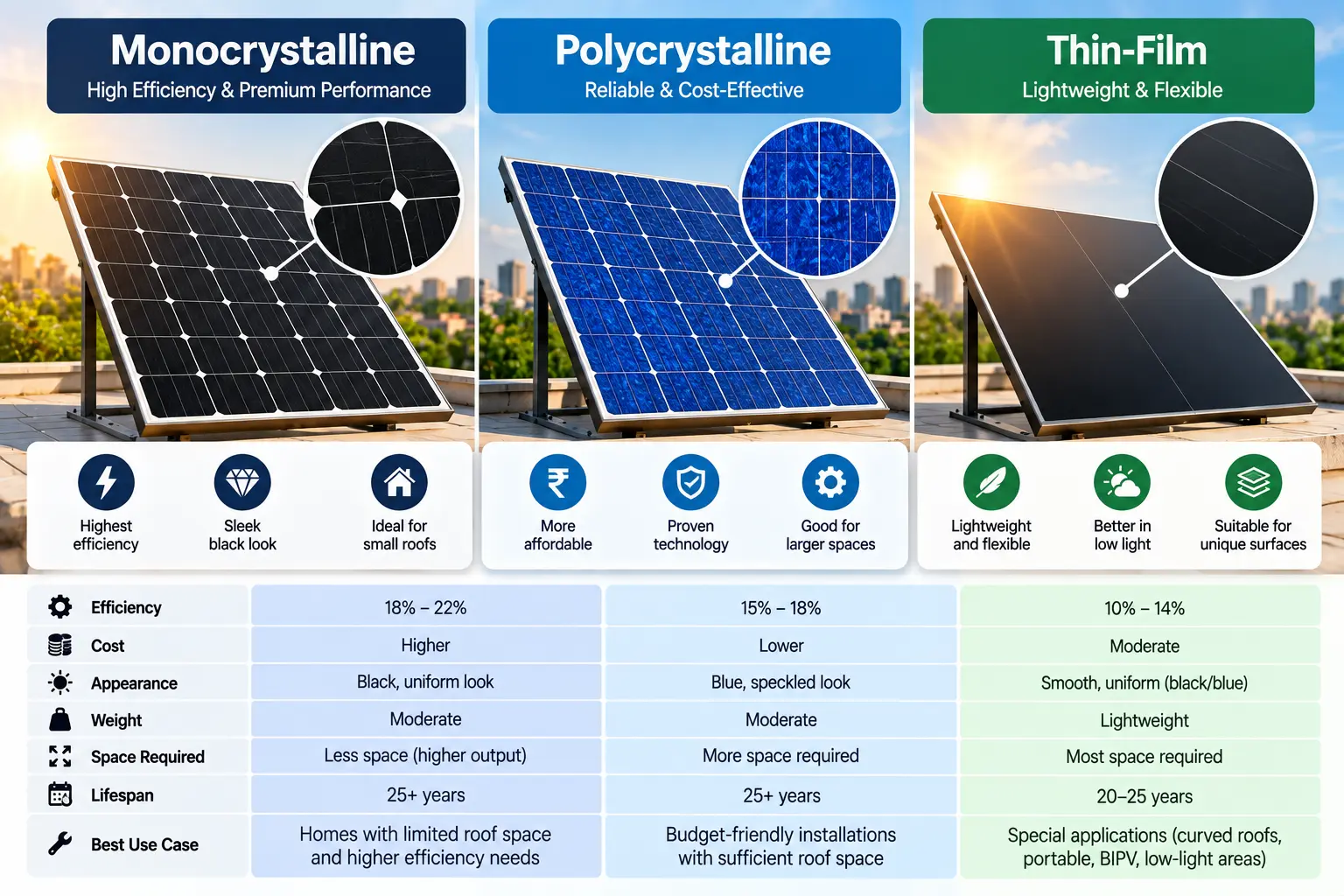
Monocrystalline panels are made by slicing thin wafers from a single, pure silicon crystal — a manufacturing process that produces the distinctive uniform black, slightly rounded-cornered cells you'll recognise on most modern rooftop installations. This single-crystal structure gives electrons a cleaner path to flow through, translating into higher efficiency (typically 19–22%, and up to 23%+ for premium panels) compared to other panel types.
Higher efficiency matters most when roof space is limited — a monocrystalline system can generate the same power output as a larger polycrystalline system while using less roof area, which is increasingly relevant for urban homes with modest rooftop space. Monocrystalline panels also tend to perform somewhat better in high-temperature conditions and in low-light scenarios (like early morning, late evening, or slightly overcast days), both of which are relevant factors across most of India's climate.
Polycrystalline and Thin-Film: Where They Fit In
Polycrystalline panels are made by melting multiple silicon fragments together into a mould, which produces the characteristic bluish, speckled appearance you might have seen on older solar installations. Because the silicon structure isn't as uniform as in monocrystalline cells, polycrystalline panels are somewhat less efficient (typically 15–18%). Historically, this was offset by a meaningfully lower manufacturing cost, making polycrystalline the more budget-friendly option — but manufacturing improvements and economies of scale have narrowed the price gap with monocrystalline considerably in recent years, to the point where monocrystalline (specifically mono-PERC) has become the practical default choice for most new rooftop installations in India today.
Thin-film panels are a fundamentally different technology, made by depositing a thin layer of photovoltaic material (commonly cadmium telluride or amorphous silicon) onto a substrate like glass or metal, rather than using silicon wafers. This makes them lightweight, flexible, and able to perform somewhat better than crystalline panels in very high-temperature or diffused-light conditions. However, their efficiency is notably lower (typically 10–13%), meaning they need significantly more surface area to generate the same power output — a limitation that makes them impractical for most standard rooftop applications, where roof space is usually the binding constraint. Thin-film panels find their niche instead in specialised applications: large-scale ground-mounted solar farms with abundant space, building-integrated solar facades, or curved and flexible surfaces where rigid crystalline panels simply won't fit.
For the vast majority of residential and commercial rooftop installations in India, the practical choice today comes down to monocrystalline (specifically mono-PERC or newer TOPCon technology) as the clear preference — the efficiency and space-saving advantages, combined with prices that have become highly competitive with polycrystalline, make it difficult to justify choosing anything else for a typical rooftop project.
Types of Solar Panels
Most rooftop solar installations in India today use one of two main panel technologies: monocrystalline and polycrystalline. Monocrystalline panels are made from a single continuous silicon crystal, giving them the highest efficiency (typically 19–22%) and the best performance in limited roof space or partial shading conditions — which is why they've become the dominant choice for residential rooftops. Polycrystalline panels, made from multiple silicon fragments melted together, are slightly less efficient (15–18%) but were historically cheaper, though the price gap with monocrystalline has narrowed significantly in recent years.
A newer generation of monocrystalline panels using PERC (Passivated Emitter and Rear Cell) or TOPCon technology pushes efficiency even higher and performs better in high-temperature conditions — a meaningful advantage during Indian summers, when panel efficiency naturally drops as temperatures rise. Thin-film panels, a third category, are lightweight and flexible but have lower efficiency and are mostly used in specialised applications rather than standard rooftops.
For most homes and businesses in India, a mono-PERC panel from a DCR (Domestic Content Requirement) approved, Tier-1 manufacturer offers the best balance of efficiency, durability, and eligibility for government subsidy schemes, which typically require DCR-compliant equipment.
Cost and Payback Period
The cost of a rooftop solar system in India varies with system size, panel and inverter brand, roof type, and installation complexity, but as a rough benchmark, a good-quality on-grid residential system typically costs between ₹50,000 and ₹65,000 per kW before subsidy, using Tier-1, DCR-compliant components. After applying the government subsidy under PM Surya Ghar (up to ₹78,000 for a 3 kW system), the net out-of-pocket cost drops meaningfully.
Payback period — the time it takes for your electricity bill savings to equal your net investment — usually works out to between 3 and 6 years for most residential and commercial systems in India, depending on your local electricity tariff, how much of your solar generation you self-consume versus export, and how well the system is sized to your actual usage pattern. After the payback period, the electricity generated is essentially free for the remaining 18–22 years of the panel's rated life, making solar one of the few home investments that pays for itself and then keeps paying dividends.
Maintenance and Lifespan
One of solar power's biggest practical advantages is how little maintenance it needs. With no moving parts, solar panels typically require nothing more than periodic cleaning to remove dust, bird droppings, and pollen that can reduce output — in most parts of India, cleaning once every 2–4 weeks (more frequently during dry, dusty months, less during and after the monsoon) is enough to keep output close to optimal.
Panels themselves are extremely durable, typically carrying a 25-year performance warranty guaranteeing they'll still produce at least 80–85% of their original rated output after a quarter century — degradation of roughly 0.5–0.8% per year is normal and expected. Inverters have a shorter lifespan than panels, typically needing replacement once every 10–15 years, so it's worth factoring this into your long-term cost calculations. Beyond cleaning and an occasional visual inspection for loose wiring or physical damage, a well-installed solar system needs very little hands-on attention to keep delivering reliable output year after year.
How to Choose the Right Solar Installer
The quality of your solar installation depends heavily on who installs it, not just what equipment you buy. When evaluating an EPC (Engineering, Procurement and Construction) company, start by checking whether they're empanelled with your state's renewable energy agency and DISCOM — this is a mandatory requirement to be eligible for government subsidy under schemes like PM Surya Ghar and PM-KUSUM.
Ask to see examples of their completed installations in your area, and if possible, speak to a couple of their past customers about the after-sales experience — how they handled warranty claims, whether the system's actual output matched what was promised, and how quickly they responded to service requests. A trustworthy installer will always conduct a proper site visit before quoting, checking your roof's shading, orientation, structural strength, and your actual electricity consumption pattern, rather than quoting a one-size-fits-all package over the phone.
Finally, insist on a clear, itemised quotation that separately lists the panel brand and wattage, inverter brand and capacity, mounting structure type, cabling and balance-of-system components, and installation charges — along with the warranty terms for each component (panels typically carry a 25-year performance warranty, inverters 5–10 years). Avoid installers who are vague about brands or bundle everything into a single opaque number.
Why Solar Makes Sense in India
India receives an average of 300 sunny days a year and among the highest solar irradiance levels in the world, which is precisely why the country has made solar power a cornerstone of its energy policy. For homeowners and businesses, this translates into a straightforward proposition: install a solar system once, and it keeps generating free electricity from sunlight for the next 25 years or more, dramatically cutting down what you pay to the grid.
Rising electricity tariffs, frequent hikes by state electricity boards, and the volatility of diesel prices for backup power have made solar an increasingly obvious financial decision, not just an environmental one. Combined with central and state government subsidies, the payback period on a typical residential or commercial rooftop solar system in India today ranges between 3 to 6 years, after which the electricity generated is effectively free for the remaining life of the system.
Beyond the financial case, solar also insulates households and businesses from unplanned power cuts, voltage fluctuations, and the uncertainty of grid supply in many semi-urban and rural parts of the country — a benefit that's often just as valuable as the money saved.
Common Myths, Busted
A persistent myth is that solar panels don't work on cloudy or rainy days — in reality, panels still generate electricity from diffused sunlight on overcast days, just at a reduced output (typically 10–25% of peak capacity), and India's overall annual sunshine is more than enough to make solar worthwhile even accounting for the monsoon months. Another common misconception is that solar panels require constant maintenance or frequent replacement — as covered above, the reality is closer to occasional cleaning with a 25-year usable life.
Many people also believe solar is only viable for large houses or businesses with big roofs, but modern high-efficiency panels mean even a modest 1–2 kW system on a small rooftop can meaningfully cut a household's electricity bill. Finally, there's a widespread assumption that solar installation is prohibitively expensive — while the upfront cost is real, government subsidy schemes, falling equipment prices, and financing options available through most installers have brought solar within reach of a much wider range of households than most people assume.
How Net Metering Works
Net metering is the billing arrangement that makes rooftop solar financially worthwhile for most Indian households and businesses. Once your solar system is installed, the DISCOM replaces your regular meter with a bi-directional net meter that can measure electricity flowing both ways — the power you draw from the grid, and the surplus solar power you export back to it.
During the day, your solar panels generate electricity that first powers whatever appliances are running in your home or business. Any extra power your panels produce beyond what you're using gets exported to the grid, and the net meter records this as a credit. In the evening or on cloudy days, when your panels aren't generating enough, you draw power back from the grid as usual. At the end of the billing cycle, you're only charged for the net units consumed — total units drawn from the grid minus total units exported to it.
This means the grid effectively acts as a free "battery" for your solar system during the day, and you only pay the DISCOM for the shortfall. For most homes with a well-sized rooftop system, this can bring monthly electricity bills down by 70–90%, and in some cases reduce them to the fixed minimum charge only.
Frequently Asked Questions
Are monocrystalline panels always the right choice?
For most rooftop installations, yes — but if you have abundant roof space and cost is the overriding priority, polycrystalline can still be a reasonable choice, since the actual generation difference on a properly sized system is smaller than the efficiency percentage alone might suggest.
Do thin-film panels ever make sense for a home rooftop?
Rarely for a typical Indian home, given the significantly larger roof area needed compared to crystalline panels for the same power output — they're better suited to large open spaces or specialised architectural applications.
Does panel type affect eligibility for government subsidy?
The subsidy under PM Surya Ghar requires DCR (Domestic Content Requirement) compliant panels rather than mandating a specific technology type, so both mono and poly panels can qualify as long as they meet DCR and quality standards — check with your installer to confirm the specific panel model is DCR-listed.
How do I know which technology a quoted panel uses?
Your installer's quotation should specify the exact panel brand and model number — you can look up the manufacturer's datasheet for that model to confirm the cell technology, efficiency rating, and temperature coefficient.
Does panel technology affect the warranty period?
Not typically — most reputable manufacturers offer similar warranty structures (around 10–12 years product warranty, 25 years performance warranty) regardless of whether the panel is mono or polycrystalline, though it's always worth confirming the specific terms for your chosen panel.
Final Thoughts
Panel technology is one of those details that's easy to gloss over when comparing solar quotes, but it directly affects how much power you'll generate from the roof space you have available. For most rooftop projects in India today, mono-PERC panels from a reputable, DCR-listed manufacturer offer the best balance of efficiency, durability, and value.