How Solar Water Pumping Systems Work: A Farmer's Guide
For farmers dealing with unreliable grid electricity or the ever-rising cost of diesel, solar water pumping has become one of the most practical upgrades available for irrigation. This guide explains how these systems actually work, the different configurations available, and what to consider before installing one on your farm.
The Basic Setup
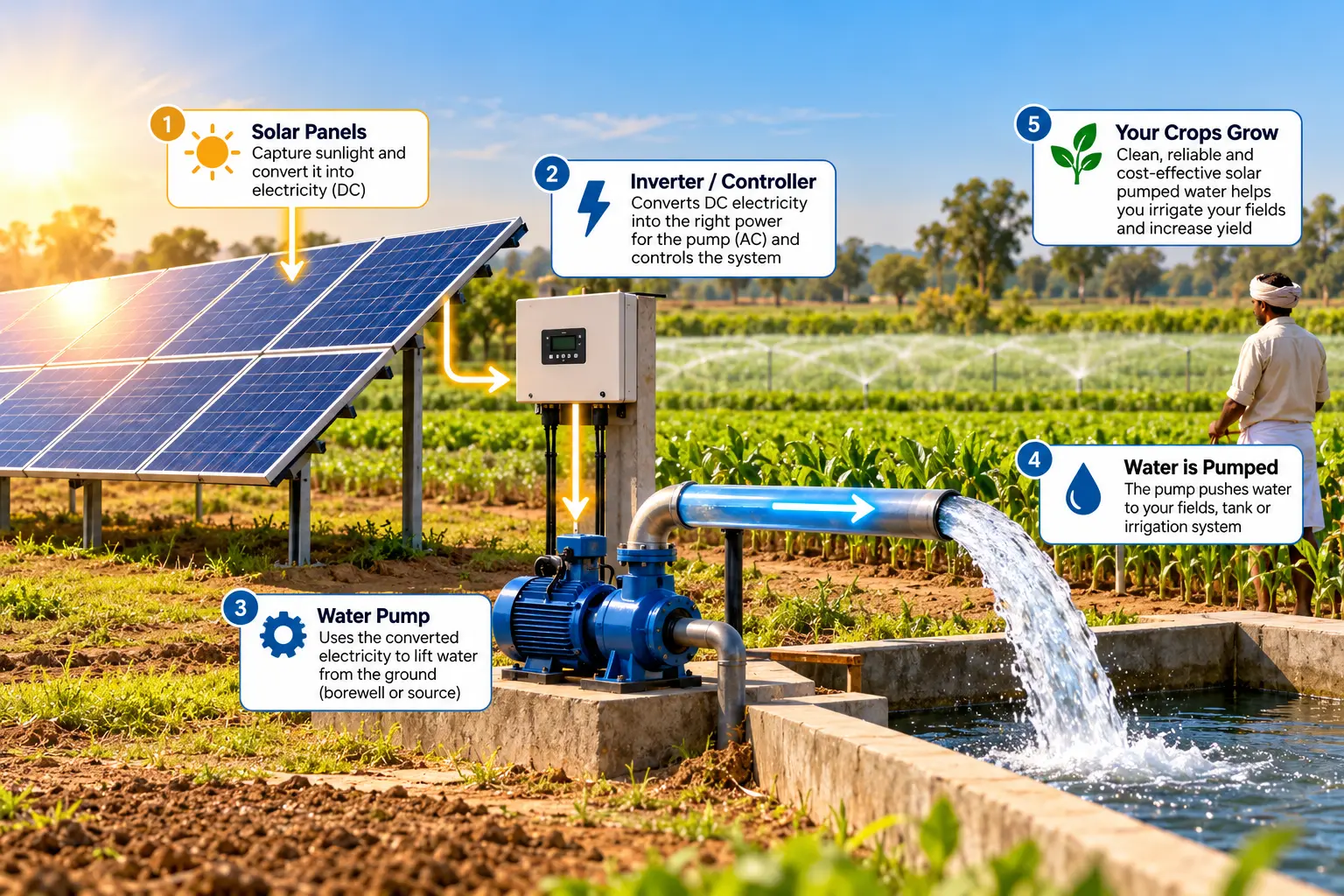
A solar water pumping system consists of three core components: solar panels (typically mounted on a fixed frame near the pump or borewell), a pump controller (which manages power delivery to match the pump's needs as sunlight intensity varies through the day), and the pump itself — either a surface pump for open wells or shallow sources, or a submersible pump for borewells. Unlike a grid-connected pump that runs at constant speed whenever switched on, a solar pump automatically adjusts its speed based on available sunlight, running faster at peak midday sun and slower during morning and evening hours.
This means solar pumps are naturally suited to daytime irrigation schedules, which conveniently also happens to be when most farmers actually want to irrigate — eliminating the need to run pumps at inconvenient hours to catch scheduled (and often unreliable) grid electricity supply windows, a common frustration for farmers dependent on grid power in many parts of rural India.
Choosing the Right Pump for Your Farm
The right pump capacity depends primarily on your water source depth, the flow rate you need for your irrigation method (drip, sprinkler, or flood irrigation each have different requirements), and your farm's total area under cultivation. Under the PM-KUSUM scheme's Component B, subsidised standalone solar pumps are typically available in capacities ranging from 1 HP to 7.5 HP, covering the needs of most small and medium landholding farmers.
For farms with an existing grid-connected pump, PM-KUSUM's Component C offers a different path — rather than replacing the pump entirely, this component helps "solarise" the existing connection, adding solar panels that offset grid electricity use and, in many cases, allow surplus solar power (when the pump isn't running) to be sold back to the local DISCOM through feed-in metering, creating a small additional income stream alongside the irrigation benefit.
A properly sized system accounts not just for today's needs but reasonable future changes too — if you're planning to bring more land under cultivation or shift to a more water-intensive crop in the coming years, it's worth discussing this with your installer during the initial sizing conversation, since correcting an undersized system later is more expensive than accounting for it upfront.
One practical consideration specific to solar pumping: since output varies with sunlight throughout the day, some farmers pair their solar pump with a small water storage tank, allowing water collected during peak sun hours to be used flexibly throughout the day and even into the evening, rather than being constrained to irrigating only during direct sunlight hours. This is a relatively low-cost addition worth discussing with your installer if flexible irrigation timing matters for your specific crops.
What Is the PM-KUSUM Scheme?
PM-KUSUM (Pradhan Mantri Kisan Urja Suraksha evam Utthaan Mahabhiyan) is the central government's flagship scheme to bring solar energy to India's farmers. Its core idea is simple: help farmers install solar power — either to run their irrigation pumps directly off solar energy or to set up small solar power plants on unused farmland — while cutting their dependence on diesel and unreliable grid electricity.
The scheme has three components. Component A lets farmers or farmer groups set up small (500 kW to 2 MW) solar power plants on barren or unused land and sell that power to the local DISCOM under a long-term power purchase agreement, turning unused land into a steady 25-year income stream. Component B provides subsidised standalone solar-powered agricultural pumps (typically up to 7.5 HP) for farmers who don't yet have a grid electricity connection for irrigation. Component C helps farmers who already have grid-connected pumps solarise them, allowing surplus solar power to be sold back to the DISCOM through net/feed-in metering.
Subsidy support under PM-KUSUM typically covers 30% from the central government and up to 30% from the state government (this varies by state), with the farmer contributing the remaining amount — a bank loan can usually cover a large part of that farmer contribution too, keeping the upfront cash outlay manageable.
Cost and Payback Period
The cost of a rooftop solar system in India varies with system size, panel and inverter brand, roof type, and installation complexity, but as a rough benchmark, a good-quality on-grid residential system typically costs between ₹50,000 and ₹65,000 per kW before subsidy, using Tier-1, DCR-compliant components. After applying the government subsidy under PM Surya Ghar (up to ₹78,000 for a 3 kW system), the net out-of-pocket cost drops meaningfully.
Payback period — the time it takes for your electricity bill savings to equal your net investment — usually works out to between 3 and 6 years for most residential and commercial systems in India, depending on your local electricity tariff, how much of your solar generation you self-consume versus export, and how well the system is sized to your actual usage pattern. After the payback period, the electricity generated is essentially free for the remaining 18–22 years of the panel's rated life, making solar one of the few home investments that pays for itself and then keeps paying dividends.
Maintenance and Lifespan
One of solar power's biggest practical advantages is how little maintenance it needs. With no moving parts, solar panels typically require nothing more than periodic cleaning to remove dust, bird droppings, and pollen that can reduce output — in most parts of India, cleaning once every 2–4 weeks (more frequently during dry, dusty months, less during and after the monsoon) is enough to keep output close to optimal.
Panels themselves are extremely durable, typically carrying a 25-year performance warranty guaranteeing they'll still produce at least 80–85% of their original rated output after a quarter century — degradation of roughly 0.5–0.8% per year is normal and expected. Inverters have a shorter lifespan than panels, typically needing replacement once every 10–15 years, so it's worth factoring this into your long-term cost calculations. Beyond cleaning and an occasional visual inspection for loose wiring or physical damage, a well-installed solar system needs very little hands-on attention to keep delivering reliable output year after year.
Documents and Application Process
Applying for solar subsidy in India, whether under PM Surya Ghar for residential rooftops or PM-KUSUM for agricultural applications, generally requires a similar set of documents: proof of identity (Aadhaar card), proof of address, a recent electricity bill showing your consumer/connection number, proof of property ownership or a no-objection certificate if you're a tenant, and bank account details (for the subsidy to be credited directly).
The typical process starts with online registration on the relevant government portal, followed by selecting your state, DISCOM, and an empanelled installer. The installer conducts a site survey, submits a technical feasibility report to the DISCOM, and — once approved — carries out the installation. After installation, the DISCOM inspects the site and installs the net meter, following which the subsidy amount is disbursed directly to the applicant's registered bank account, typically within 30 to 45 days of the net meter going live.
Why Solar Makes Sense in India
India receives an average of 300 sunny days a year and among the highest solar irradiance levels in the world, which is precisely why the country has made solar power a cornerstone of its energy policy. For homeowners and businesses, this translates into a straightforward proposition: install a solar system once, and it keeps generating free electricity from sunlight for the next 25 years or more, dramatically cutting down what you pay to the grid.
Rising electricity tariffs, frequent hikes by state electricity boards, and the volatility of diesel prices for backup power have made solar an increasingly obvious financial decision, not just an environmental one. Combined with central and state government subsidies, the payback period on a typical residential or commercial rooftop solar system in India today ranges between 3 to 6 years, after which the electricity generated is effectively free for the remaining life of the system.
Beyond the financial case, solar also insulates households and businesses from unplanned power cuts, voltage fluctuations, and the uncertainty of grid supply in many semi-urban and rural parts of the country — a benefit that's often just as valuable as the money saved.
Common Myths, Busted
A persistent myth is that solar panels don't work on cloudy or rainy days — in reality, panels still generate electricity from diffused sunlight on overcast days, just at a reduced output (typically 10–25% of peak capacity), and India's overall annual sunshine is more than enough to make solar worthwhile even accounting for the monsoon months. Another common misconception is that solar panels require constant maintenance or frequent replacement — as covered above, the reality is closer to occasional cleaning with a 25-year usable life.
Many people also believe solar is only viable for large houses or businesses with big roofs, but modern high-efficiency panels mean even a modest 1–2 kW system on a small rooftop can meaningfully cut a household's electricity bill. Finally, there's a widespread assumption that solar installation is prohibitively expensive — while the upfront cost is real, government subsidy schemes, falling equipment prices, and financing options available through most installers have brought solar within reach of a much wider range of households than most people assume.
How to Choose the Right Solar Installer
The quality of your solar installation depends heavily on who installs it, not just what equipment you buy. When evaluating an EPC (Engineering, Procurement and Construction) company, start by checking whether they're empanelled with your state's renewable energy agency and DISCOM — this is a mandatory requirement to be eligible for government subsidy under schemes like PM Surya Ghar and PM-KUSUM.
Ask to see examples of their completed installations in your area, and if possible, speak to a couple of their past customers about the after-sales experience — how they handled warranty claims, whether the system's actual output matched what was promised, and how quickly they responded to service requests. A trustworthy installer will always conduct a proper site visit before quoting, checking your roof's shading, orientation, structural strength, and your actual electricity consumption pattern, rather than quoting a one-size-fits-all package over the phone.
Finally, insist on a clear, itemised quotation that separately lists the panel brand and wattage, inverter brand and capacity, mounting structure type, cabling and balance-of-system components, and installation charges — along with the warranty terms for each component (panels typically carry a 25-year performance warranty, inverters 5–10 years). Avoid installers who are vague about brands or bundle everything into a single opaque number.
Frequently Asked Questions
How much does a solar water pump typically cost after PM-KUSUM subsidy?
This varies significantly by pump capacity and your specific state's subsidy structure (state subsidy percentages differ), but subsidised systems are generally designed to be affordable for small and medium farmers, with the farmer's contribution often further supported through accessible bank financing.
Does a solar pump work during cloudy or monsoon days?
Yes, though at reduced output compared to full sun — for farms in regions with a pronounced monsoon season, some farmers factor this into their irrigation planning, relying more on solar during the dry season when sunlight is most consistent.
Can a solar pump run at night if I need it to?
A pure solar pump (without battery storage) only runs during daylight hours. If nighttime irrigation is essential for your specific crop or schedule, this is worth discussing with your installer — either through a battery-backed system or by pairing solar pumping with water storage for later use.
How long does a solar water pump system typically last?
The solar panels themselves typically carry a 25-year performance warranty, similar to rooftop solar panels, while the pump and motor components generally have a somewhat shorter lifespan (often 10-15 years) depending on usage intensity and water quality, similar to any submersible or surface pump.
Is maintenance different for a solar pump compared to a regular electric pump?
The pump and motor maintenance needs are broadly similar to any electric pump, with the addition of periodic solar panel cleaning (similar to rooftop panels) to maintain optimal power output to the pump.
Final Thoughts
For farmers frustrated by unreliable grid power or the rising cost of diesel, solar water pumping offers a genuinely practical alternative — reliable daytime irrigation, low ongoing running costs, and government subsidy support that makes the upfront investment considerably more manageable. It's worth a proper site assessment from a PM-KUSUM empanelled installer to understand exactly what capacity and configuration suits your specific land and crop needs.